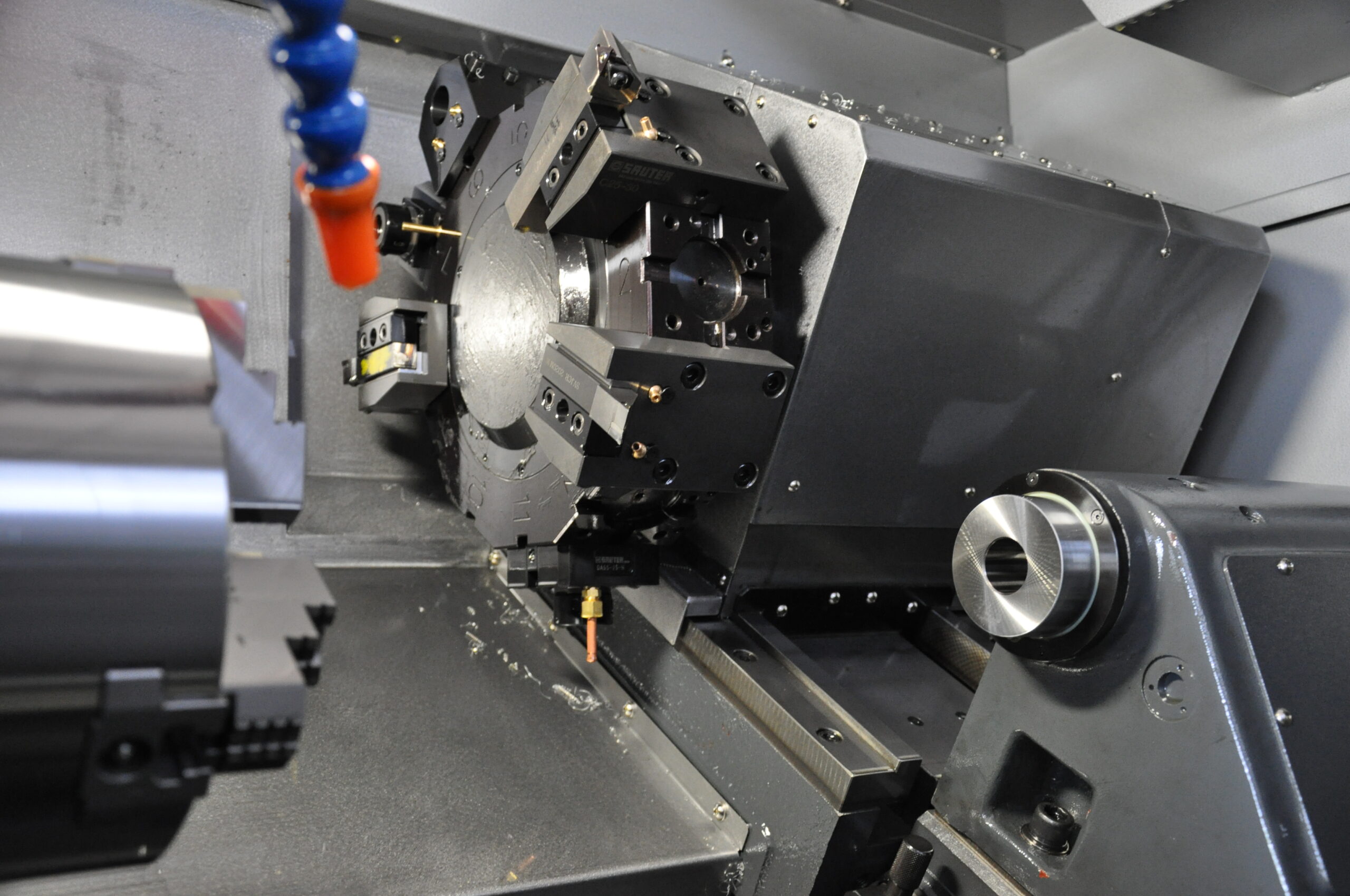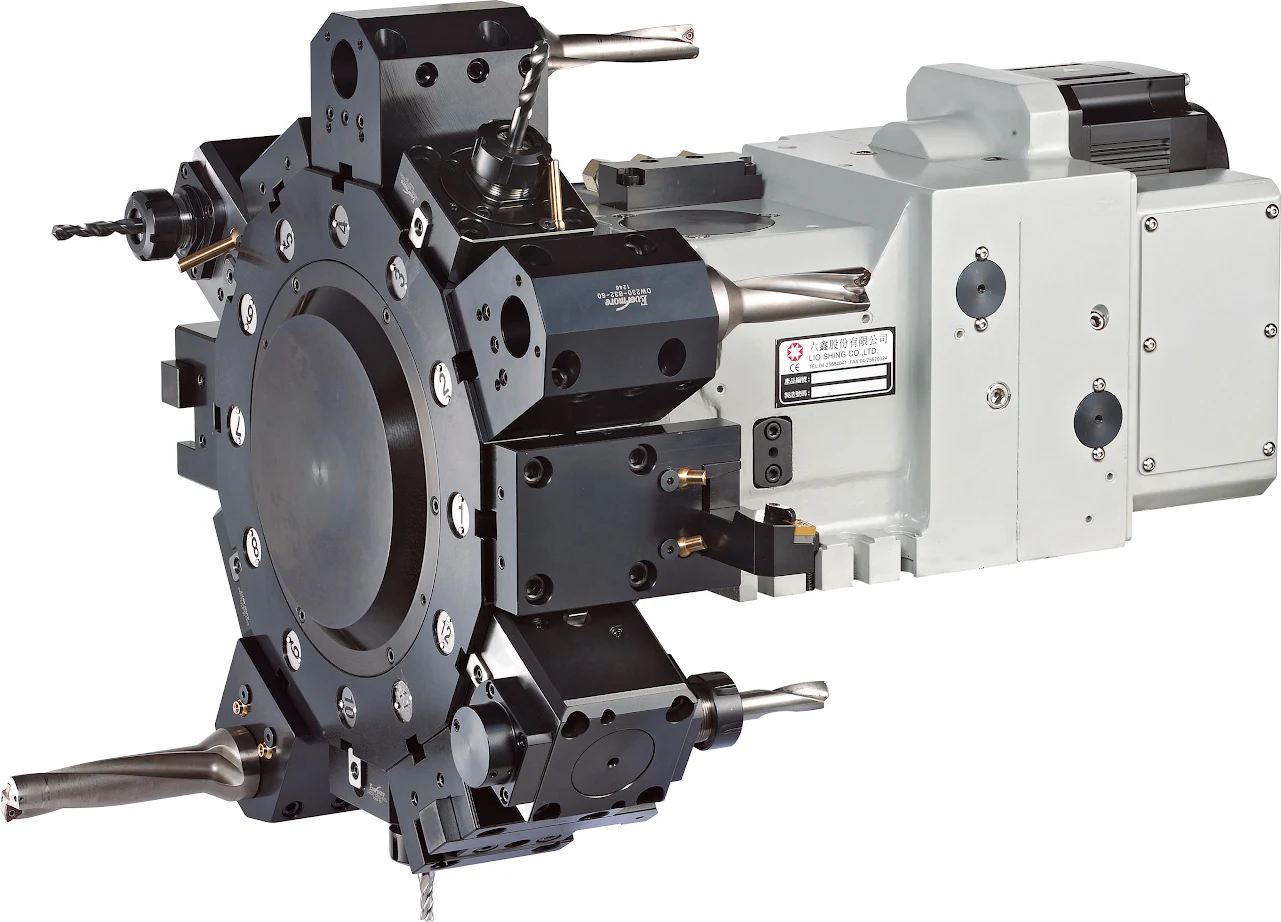
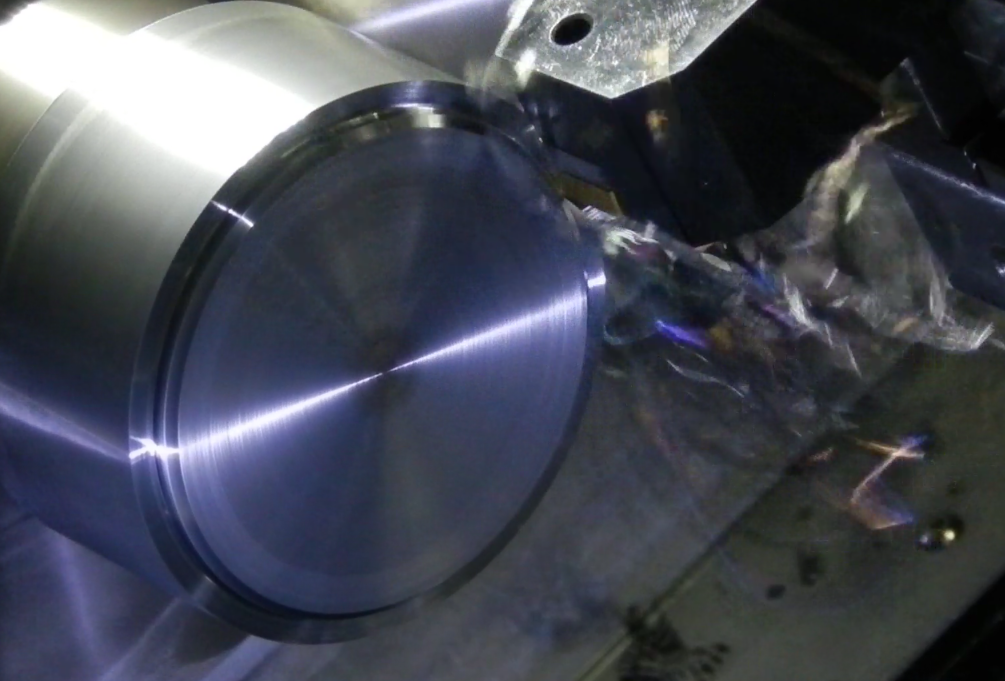
Gang-Type / Conventional CNC Lathe operates on the principle of "workpiece rotates at a fixed point, tool moves to cut" — the chuck grips and rotates the material while the turret moves on multiple axes to complete each operation. High rigidity and broad versatility make it ideal for short, large-diameter, or heavy-duty workpieces with L/D less than 3.
Swiss-Type Lathe: The Specialist for Slender Precision Parts
The Swiss-type lathe (also called a sliding headstock lathe) originated in the Swiss watchmaking industry, originally designed to machine tiny watch components. Its core design feature is a guide bushing positioned very close to the spindle mouth.
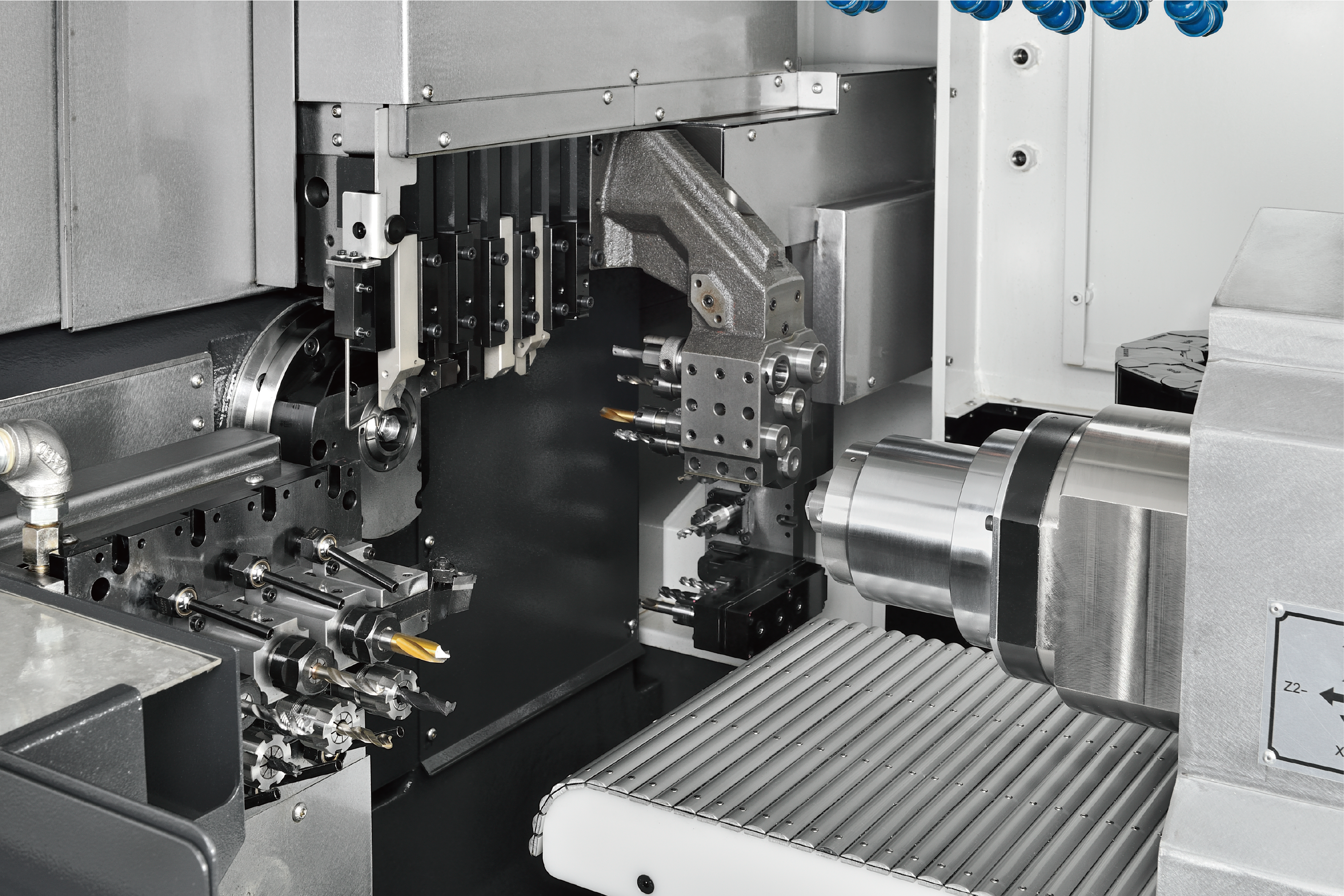
Swiss-type lathe guide bushing and gang tool configuration
The primary advantage of the Swiss-type is that the guide bushing virtually eliminates machining vibration. Even slender workpieces with L/D greater than 3 can be cut stably, with accuracy in the micron range. Multiple tools are also available simultaneously, allowing turning, milling, drilling, and tapping to be completed in a single setup.
- Best for: Slender bar stock with L/D > 3 — guide bushing support makes vibration virtually zero
- Machining characteristics: Extremely high accuracy, compound operations completed in one setup (turning, milling, drilling, tapping)
- Primary applications: Medical devices, watch components, aerospace micro-parts, electronic connectors
- Notes: Requires high bar stock straightness; remnant material is longer, so material utilization is slightly lower
Gang-Type Lathe: The Mainstream General-Purpose CNC Lathe
The gang-type is the most common standard CNC lathe configuration today — what most people mean when they say "conventional CNC lathe." After the chuck grips the material, the spindle drives the material to rotate at a fixed point while the turret moves on multiple axes (X/Z) to perform cutting.
Because the spindle is fixed and the machine body has high structural rigidity, the gang-type is especially suited for heavy-duty machining requiring large cutting forces, as well as larger-diameter, shorter-length workpieces.
- Best for: Short parts with L/D < 3, or large-diameter workpieces requiring heavy-duty cutting
- Machining characteristics: High rigidity, strong heavy-duty cutting capability, broad material versatility
- Primary applications: Automotive and motorcycle parts, general hardware, hydraulic components, mold machining
- Notes: Chatter becomes an issue at high L/D ratios — not suitable for slender parts with L/D > 3
Swiss-Type vs Gang-Type: Six Key Differences at a Glance
The following comparison covers six dimensions — from machining principle to material waste — directly contrasting the core differences between these two machine types:
| Comparison Item | Swiss-Type | Gang-Type |
|---|---|---|
| Cutting Principle | Fixed tool, bar stock moves (feeds through bushing) | Workpiece rotates at fixed point, tool moves on multiple axes |
| Suitable L/D Ratio | Slender parts L/D > 3 — ideal application | Short parts L/D < 3 — optimal performance |
| Vibration Control | Guide bushing provides extremely close support — virtually zero vibration | Rigid structure damps vibration — less effective at high L/D |
| Machining Accuracy | Extremely high — minimal vibration, stable micron-level accuracy | High — slightly lower than Swiss-type for slender parts |
| Material Waste | Longer remnant stock — lower material utilization | Short remnant — higher material utilization |
| Primary Applications | Medical, aerospace, watchmaking, electronic precision parts | Automotive, hardware, heavy-duty cutting, general manufacturing |
How to Choose? Two Questions That Lead You to the Answer
There is no universally "best" machine — only the most suitable one. Ask yourself two questions before choosing, and the answer will become clear:
If your workpieces span both requirements, or you simultaneously need to machine slender precision parts and short heavy-duty parts, AEGIS CNC offers a complete lineup of both Swiss-type and gang-type configurations. Our technical team can provide machine selection recommendations based on your actual production plan.