CNC Safety Guide / Safe Operation Guidelines

Mastering CNC Lathe Safe Operation Guidelines

A comprehensive guide to the safety knowledge every CNC lathe operator must know — covering common hazards, dress code requirements, and mandatory safety certifications for equipment procurement.

Beginner Safety Guidelines AEGIS CNC Technical Knowledge Hub
CORE DEFINITION CNC lathes are high-speed, high-power machining equipment. A single moment of inattention can range from a machine crash and tool damage to irreversible personal injury. Safety is the highest form of productivity. Even the safest machine requires an equally safety-conscious operator.

Types of Common Dangers When Operating a CNC Lathe

Before learning the operating rules, understand the three most frequent hazard types in CNC lathe environments — so you know what each safety rule is actually preventing.
Most Common & Most Dangerous
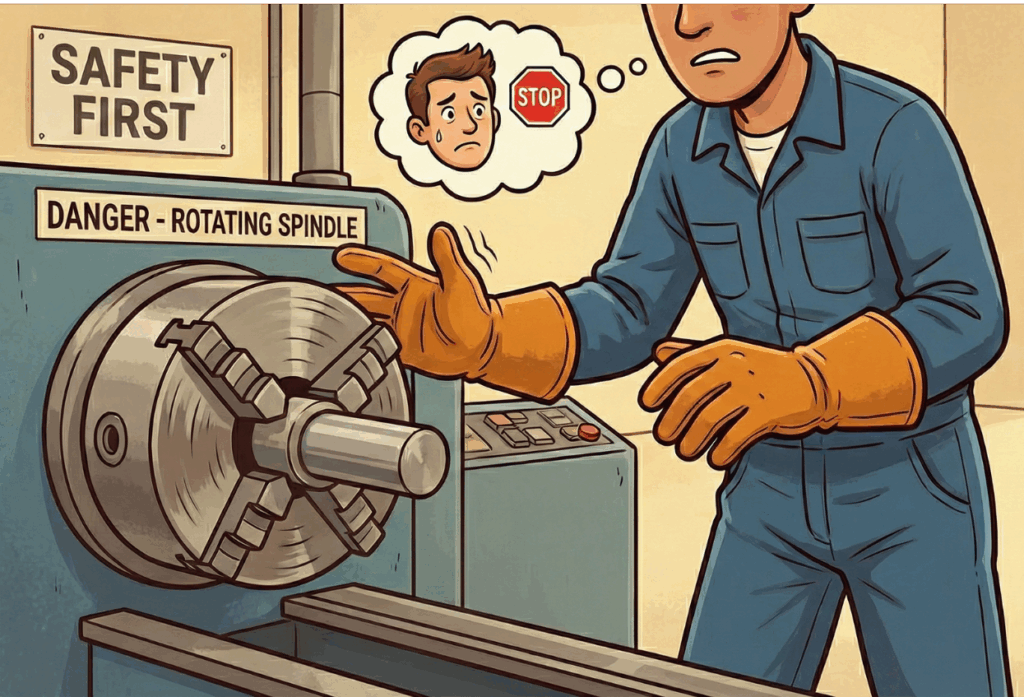
Entanglement Injury
When the spindle rotates at high speed, clothing, gloves, or loose hair near the rotating zone can be caught instantly, causing severe lacerations. Escape is impossible once it happens — this is the most fatal hazard type.
Projectile Injury
Flying Metal Chips & Ejected Workpieces
High-temperature metal chips generated during turning, and workpieces that eject due to inadequate clamping, can strike the body at extreme velocity. Their penetrating force should never be underestimated.
Laceration
Chip Cuts
Turning chips appear harmless but are as sharp as blades, with serrated edges. Bare-hand contact causes deep lacerations and is most common during machine cleaning.
CNC lathe entanglement hazard warning: operator approaching rotating chuck, illustrating glove entanglement danger

Operator Dress Code & Personal Protective Equipment

Clothing is the most common yet most overlooked safety hazard on the shop floor. Here is a clear comparison of what is prohibited versus what is required:
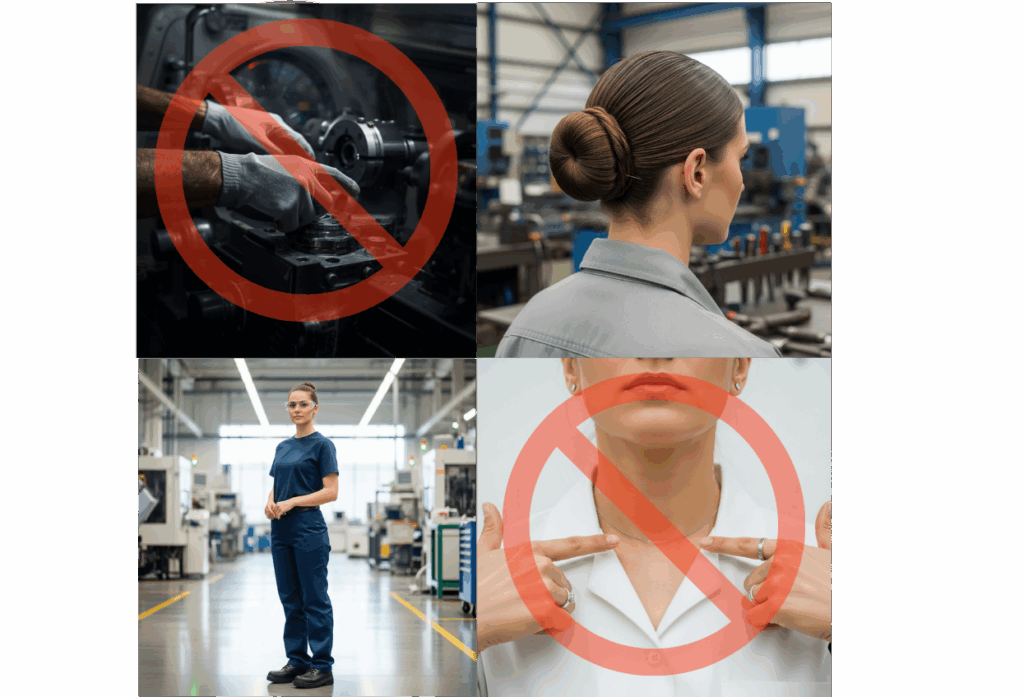
❌ Prohibited
No Cotton or Fabric GlovesCotton or canvas gloves catch on burrs easily and resist tearing — once caught, they drag the entire hand into the machine
No Loose Long HairLong hair must be fully pinned up or tucked into a safety cap; loose hair risks being drawn into the rotating spindle
No JewelryNecklaces, bracelets, and watches are all dangling items that can catch and cause entanglement injury
No Loose-Fitting ClothingWide sleeves or loose garment hems carry the same entanglement risk as gloves
✓ Required Equipment
Safety GlassesWorn at all times during machining to protect eyes from flying chips and coolant splash — must not be removed
Safety ShoesSteel-toe protection against crushing injuries from dropped workpieces or tools
Fitted Work UniformCuffed sleeves that resist snagging, with basic oil and coolant resistance
Dedicated Chip-Removal ToolsUse a hook or brush; never touch any metal chips or swarf with bare hands
CNC lathe safe dress code diagram: no gloves, correct hair restraint, proper uniform, no jewelry — four-item comparison

Pre-Operation Checklist & In-Process Safety Rules

The verification steps before starting the machine, and the behavioral rules that must never be violated during machining, form the critical defense line against the vast majority of factory accidents.
Statistics show that the losses caused by factory accidents are nearly always far greater than the cost of machine maintenance
The vast majority of accidents originate not from equipment failure, but from the "it'll be fine this time" mindset
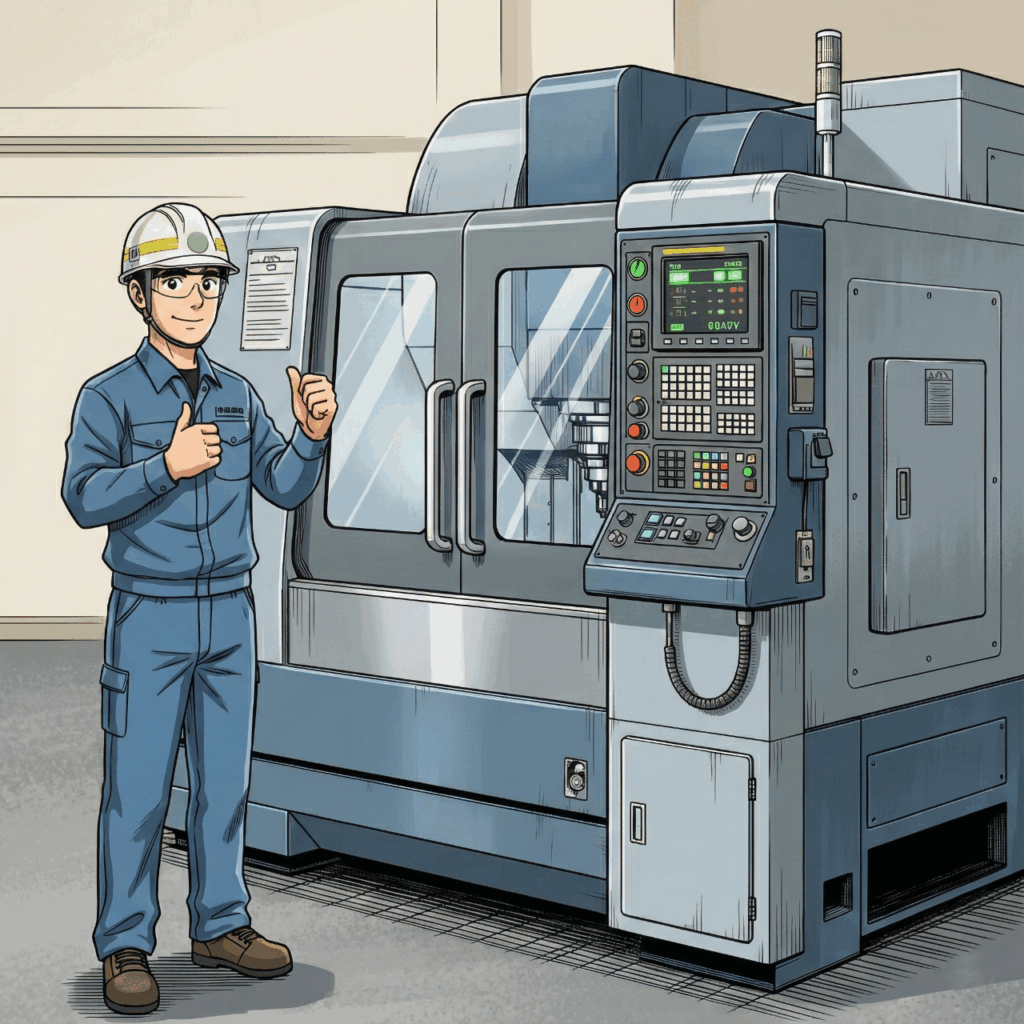
CNC lathe safe operation demonstration: operator in correct PPE giving thumbs up beside the machine, signaling safety check passed

Pre-Operation Mandatory Checks:

  • Workpiece Clamping VerifiedBefore starting the spindle, confirm adequate clamping pressure and that the chuck is fully locked to prevent workpiece ejection during high-speed rotation
  • All Safety Guards ClosedThe machining enclosure door, electrical cabinet door, and maintenance panels must all be fully closed; the safety interlock must never be bypassed in any way
  • Tool Offset ConfirmedVerify all tool length offsets have been entered correctly to prevent a crash on the first part due to mismatch between program and actual tool length

Strictly Prohibited During Machining:

  • Stopping the Spindle by HandNever use your hand to forcibly stop a rotating chuck; the inertial force far exceeds expectations. Always wait for the machine to come to a complete stop
  • Measuring While the Spindle Is MovingWorkpiece measurement must only be performed after the spindle has completely stopped; even 0.1 seconds of dynamic contact can cause injury
  • Opening the Guard Door During OperationNever open the machining enclosure door while the machine is running; if you detect unusual noise, abnormal vibration, or an operating error, press the emergency stop immediately
  • Pulling Chips with Bare HandsTurning chips are sharp and hot; fully stop the machine and wait for the chuck to be stationary before removing chips with a dedicated hook or brush
  • Entering the Machining Zone Without Pressing E-StopWhenever your body must enter the machining or maintenance zone, press the emergency stop first to ensure the machine cannot activate for any reason
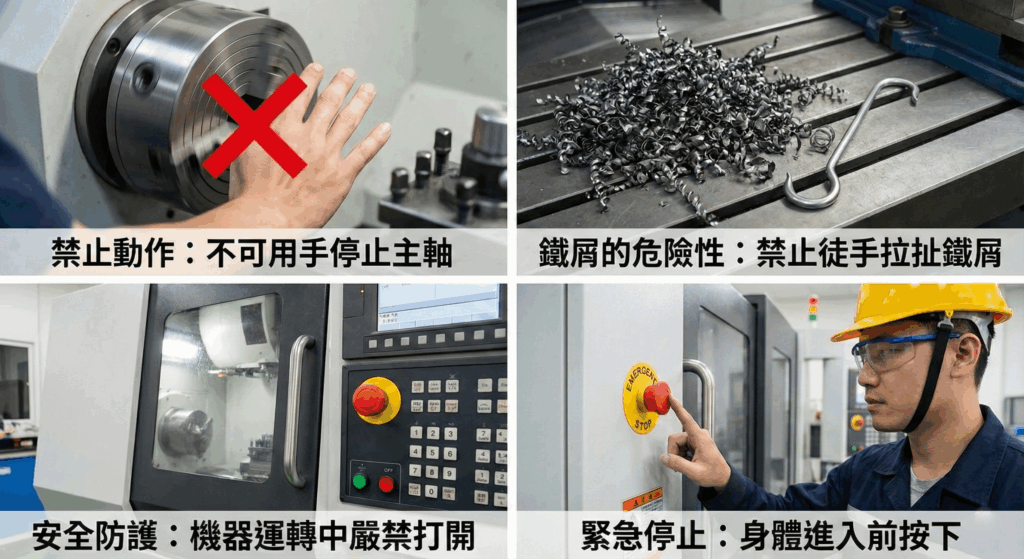
CNC lathe four in-process prohibitions diagram: no hand-stopping spindle, no pulling chips, no opening guard door, press E-stop before entering

Machine Safety Certifications Explained: CE & TS Marks

Beyond operator procedures, the machine's own safety design is equally critical. When purchasing equipment, CE and TS marks are not just stickers — they are legally binding commitments to human safety.

CE Certification
CE Mark (Conformité Européenne)
A mandatory EU safety certification and one of the world's most recognized standards, confirming the machine design meets international "inherent safety" requirements.
  • Compliant with EU Machinery Directive, Low Voltage Directive, and Electromagnetic Compatibility Directive
  • Rigorous electrical safety circuit design and safety guard strength testing
  • Noise control standards meet EU regulatory requirements
  • A mandatory requirement for export to the EU market and a symbol of international trust
TS Mark — Taiwan Safety
TS Mark (Taiwan Safety Mark)
Administered by Taiwan's Occupational Safety and Health Administration under the Ministry of Labor, the TS Mark registration is a hard legal requirement for lawful sale in Taiwan.
  • In Taiwan, regulated machinery (including CNC lathes and machining centers) must carry the TS Mark to be legally sold and operated
  • Safety functions including emergency stop and guard interlocks must pass third-party verification
  • Purchasing machines without a TS Mark exposes employers to substantial liability and criminal penalties
  • All AEGIS CNC machine models are TS Mark certified
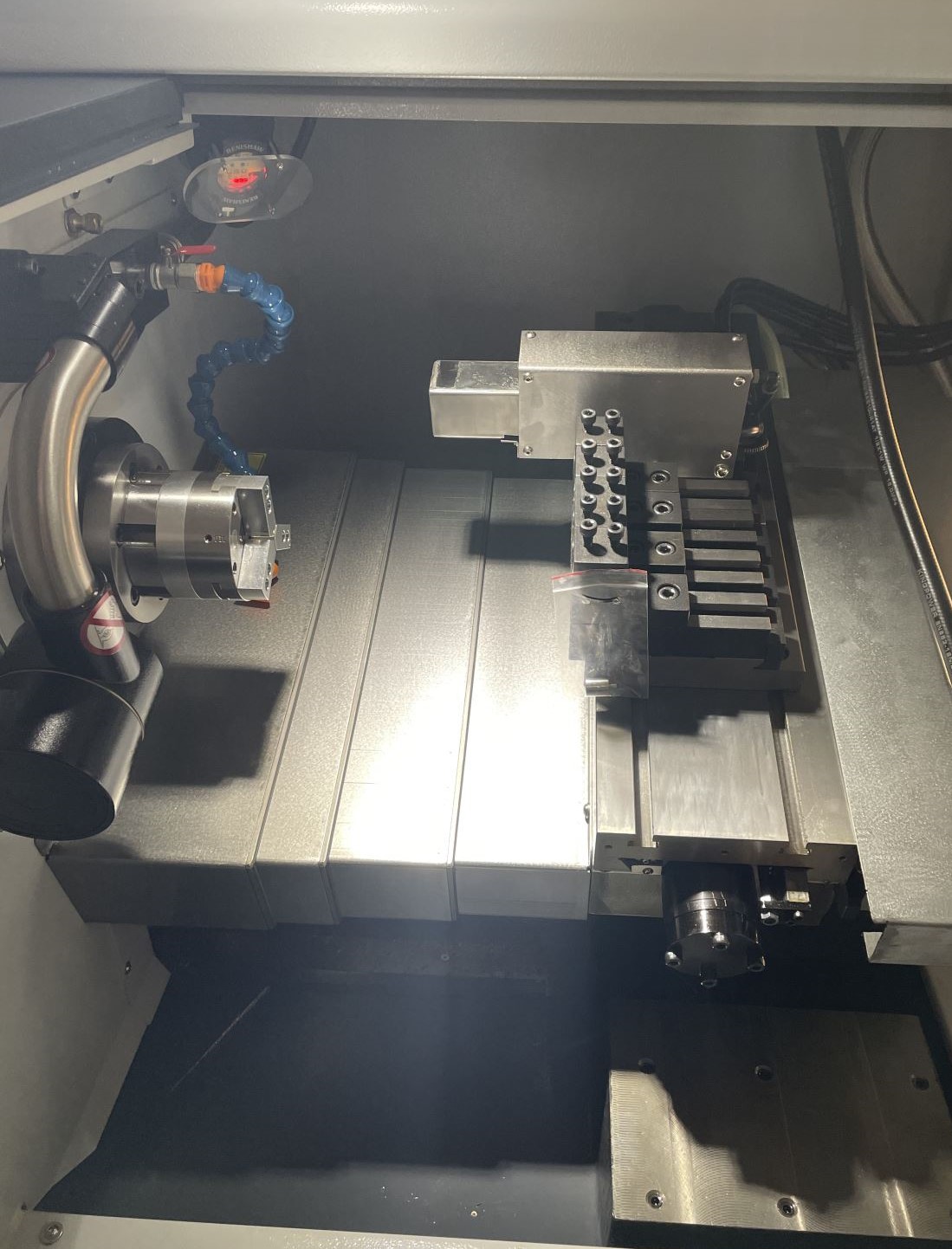
Safety is AEGIS CNC's most unwavering commitment to every customer
Every AEGIS CNC lathe and Turn-Mill Center is designed and manufactured in strict compliance with CE and TS safety standards — giving operators confidence and managers peace of mind

AEGIS CNC / SAFETY ASSURANCE

Want to Learn About AEGIS Machine Safety Specifications?

All AEGIS CNC machine models are CE and TS certified with comprehensive safety protection design. Contact our technical team to learn about the safety solutions best suited to your production needs.